`
`
`

`
`
`
`
Albino Luciani = White Light
`
``
`
White Light Dark Night
`
`
`
Preface
`
`
``
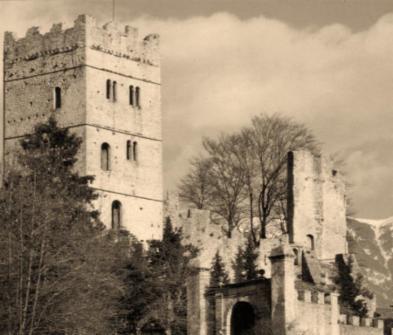
The bishop's castle at Vittorio Veneto
`
`
`
`
For those of us who remember him, I bring nothing new. But for those of us who have allowed the Church’s misrepresentations of what he was all about, who have allowed its falsehoods to distort his legacy, I bring a treasure trove of yesterday.
Under St. Peter’s is a slab of granite, “IOANNES PAVLVS P. P. I”
Like its counterpart in Arlington, it too marks an unknown tomb, The Tomb of the Unknown Pope. Unlike the tombs of other popes which tell of their lives, there is no inscription other than his name. Not even the period of reign marks his place in time. The Church would rather his life remain a secret, The Secret Life of John Paul. The only pope in modern history for which the Vatican has not commissioned a biography be written. White Light Dark Night is the only existing biography of the 33-day Pope.
The dialogue herein is both italicized and unitalicized. Italicized quotes are supported by direct references. Unitalicized dialogue, although representative of what was actually said by real people, is not supported by public record or documentation.
In order to describe events as close to how they actually happened, this book is written in several genres. This should make it more enjoyable to read and keep it from being the dry narrative that most biographies tend to be. Footnotes are at chapter ends.
`
`
The missing will
`
In the fall of 1978, I had scheduled a vacation to visit my friend Jack Champney in the Vatican. The nature of my visit would change when John Paul died. I would console Jack who had been so close to the Pope. A couple of days later, it would change again when Jack was killed by a hit-run driver and shipped back home.
Though I had my suspicions at the time, I have no evidence to this day other than coincidence that Jack’s murder was linked to that of his long term friend and confidant Albino Luciani.
Nevertheless, I kept my date. When the Opus Dei candidate – the Polish cardinal - rose to power, I grew concerned. I flew to the Veneto country where Luciani had spent his ministry.
I visited Jack’s good friend Antonio Cunial who at the time was serving as bishop of Vittorio Veneto. I hoped to secure some of Luciani’s records that I might someday put them to writing. He told me that a group from the Vatican Foreign Minister’s office had shown up the week before and had taken everything with them. I asked him why he had surrendered the records.
As part of standard indoctrination, an incoming Pope is required to file his will with the Vatican. Although the Vatican Clerk insisted he had secured the will from Venice a few days after Luciani’s election, it had been lost in the Vatican offices. After the Pope’s death, his lawyer in Venice was asked to send another copy to Rome. At first he complied. A few days later, he sent a message he had discovered Albino Luciani’s will missing from his files.
Cunial told me, when confronted, he had called Luciani’s lawyer and was told Luciani’s will had provided that his records pertaining to his ministries as a priest and a bishop had been willed to the dioceses of Belluno and Vittorio Veneto. Yet, in that the will could not be found, he had no authority to resist and surrendered the records. To this day, Luciani’s will has never been found.
The bishop told me something else. There had been a break-in at the local newspaper and some of its archives had been stolen. This did not mean much to me as when he was bishop of Vittorio Veneto most of the more important things Luciani said and did reached notoriety and were recorded in many newspapers. This is why what I have to say about his time as a bishop and as a cardinal is so well supported in this book; direct references from scores of newspapers and other public records that survived the Vatican’s attempt to annihilate the controversial life of Albino Luciani.
As a common priest, however, he was not widely known and one would be dependent almost entirely on Belluno’s Corriere delle Alpi for those twenty years he spoke out against the Vatican on humane issues. I arrived in Belluno too late; another break-in. Also, Bishop Ducoli had given up Luciani’s records on request. This part of his life had vanished as if it had never existed.
So for his time as a child, as an outspoken seminarian and as a revolutionary priest, except for some of his more outlandish attacks on the Vatican which reached notoriety, I rely primarily on my direct witness; my personal encounters with the man himself.
I recall each moment of them as if it were yesterday. I relished those times as I witnessed this good man Luciani smiling, grinning, laughing, teasing, joking and then smiling some more.
He went into great detail and spoke hours on end of his days as a teenage troublemaker in the seminary at Feltre and I recount much of that here. He had less to say of his days in the major seminary at Belluno and as a young priest. Yet, he gave me enough to bridge the gap between his time at Feltre and the time he became a bishop where the record reaches firmness once more.
A great deal of what I talk about here is the record of my friend Jack’s correspondence and the many conversations he had with me. In a few cases, I have clarified what Jack had to say in his letters. Only one arrived during John Paul’s papacy.
`
`
`
`
`
`
`
The old box
`
There is an old shoebox on the top shelf of my closet. I guard it with my life. For it is my treasure, you see. I want to share a bit of it with you.
`
`
`
`
`
`
Albino Luciani = White Light
`
``
`
White Light Dark Night